It’s now been almost 2 years since I wrote my last post
and put that part of life on hold for a little while. I loved putting this
little blog together – and when I look back on some of the things I wrote I
feel quite proud, both for making the time to do something I love and
for the effort, research, and writing time I put into it. Now I feel a small sense of regret for putting it
on hold, since in the past 2 years the internet has really exploded with blogs
on the topic of nutrition and health. There were quite a few out there when I
started but now there really are a LOT. So what to do? Pat myself on the back
and say oh well, I gave it a good try? That wasn’t really the point. Recently
have I started to think about getting back into writing about nutrition, and it
has quickly become clear that it’s what I want to do again. The knowledge gained from the act researching for, and
writing each article was always worth it, as was the satisfaction of just doing
something that I enjoy.
Now nearly 2 years later, I’m not longer fresh from a big move overseas,
trying to get my qualifications transferred and finding my feet as a new
graduate nurse in a different country than where I trained. I’m not longer
wondering when my husband’s immigration papers will go through so that we
aren’t living on the other side of the world from each other. I have now
been studying natural nutrition for a year and a half and live in an apartment
that is quiet, warm, cozy and just the right size for us. Although
it’s not the city we pictured living in, we are lucky to live in a beautiful
old neighbourhood, with interesting old homes and the river valley at our
doorstep. Our neighbourhood and apartment are perfect for spending my days off from
working at the hospital doing what I love: cooking, going to
yoga/bootcamp/trail running, studying and now - writing.
My blog may not be fancy and my
knowledge of websites is still basic, but hopefully I can teach myself
a thing or two in that area. Even
so, this is my own space for sharing what I love do to with those who are
interested, and I think there are a lot of people out there who want to know
more and who want to make some changes to the way they eat. What I write about it
how I see it, what I have learned from many reputable sources, and how I try to live life
every day. So if this sounds like your cup of tea, stay tuned for some topics that I hope you will find interesting and helpful in the world of natural nutrition.

Monday, December 8, 2014

Wednesday, February 27, 2013
Healthy On-The-Go Lunch Ideas
If you're like me, lunches are always the hardest meal to plan for the week. Normally I like to try and make enough leftovers from dinner to use for lunches, but this doesn't always work out! If you take out the option of the standard sandwich-and-processed luncheon meat, then things can get a bit tricky. Thankfully I've managed to learn a couple of healthy lunches to make that are not very time-consuming and are also easy to take with you and put together at lunch time. If you're really hungry at lunch like me, you can also add more options - I like to have herbal tea, a piece of fruit, nuts and maybe a homemade cookie or Lara bar. Leftover soup in a thermos also works well with both of these.
Healthy Lunch #1
 Chicken & Veggie Salad
Ingredients:
-Leftover cooked chicken (especially easy if you've cooked a whole chicken for another meal and saved some for lunches.)
-1/2 an Avocado
-1-2 Green onions, chopped
-1 Tomato
-1/2 Small cucumber, sliced
-Mixed salad greens
-Dressing: Olive oil and balsamic vinegar with a squeeze of lemon juice
 Healthy Lunch #2
Spelt Toast with Avocado, Cheese, Cucumber, Tomato and Pepper
Ingredients:
-1/2 Avocado
-4 Slices of cheese of your choice
-1/2 small cucumer
-1 Tomato
-2 Pieces Spelt Bread or other gluten-free bread
-Ground Pepper
What do you make for a healthy lunch to take with you to work or school? Maybe you can offer some inspiration to myself and others :)
Healthy Lunch #1
 Chicken & Veggie Salad
Ingredients:
-Leftover cooked chicken (especially easy if you've cooked a whole chicken for another meal and saved some for lunches.)
-1/2 an Avocado
-1-2 Green onions, chopped
-1 Tomato
-1/2 Small cucumber, sliced
-Mixed salad greens
-Dressing: Olive oil and balsamic vinegar with a squeeze of lemon juice

Spelt Toast with Avocado, Cheese, Cucumber, Tomato and Pepper
Ingredients:
-1/2 Avocado
-4 Slices of cheese of your choice
-1/2 small cucumer
-1 Tomato
-2 Pieces Spelt Bread or other gluten-free bread
-Ground Pepper
What do you make for a healthy lunch to take with you to work or school? Maybe you can offer some inspiration to myself and others :)
Friday, February 8, 2013
Leek & Chicken Soup (GF, DF)
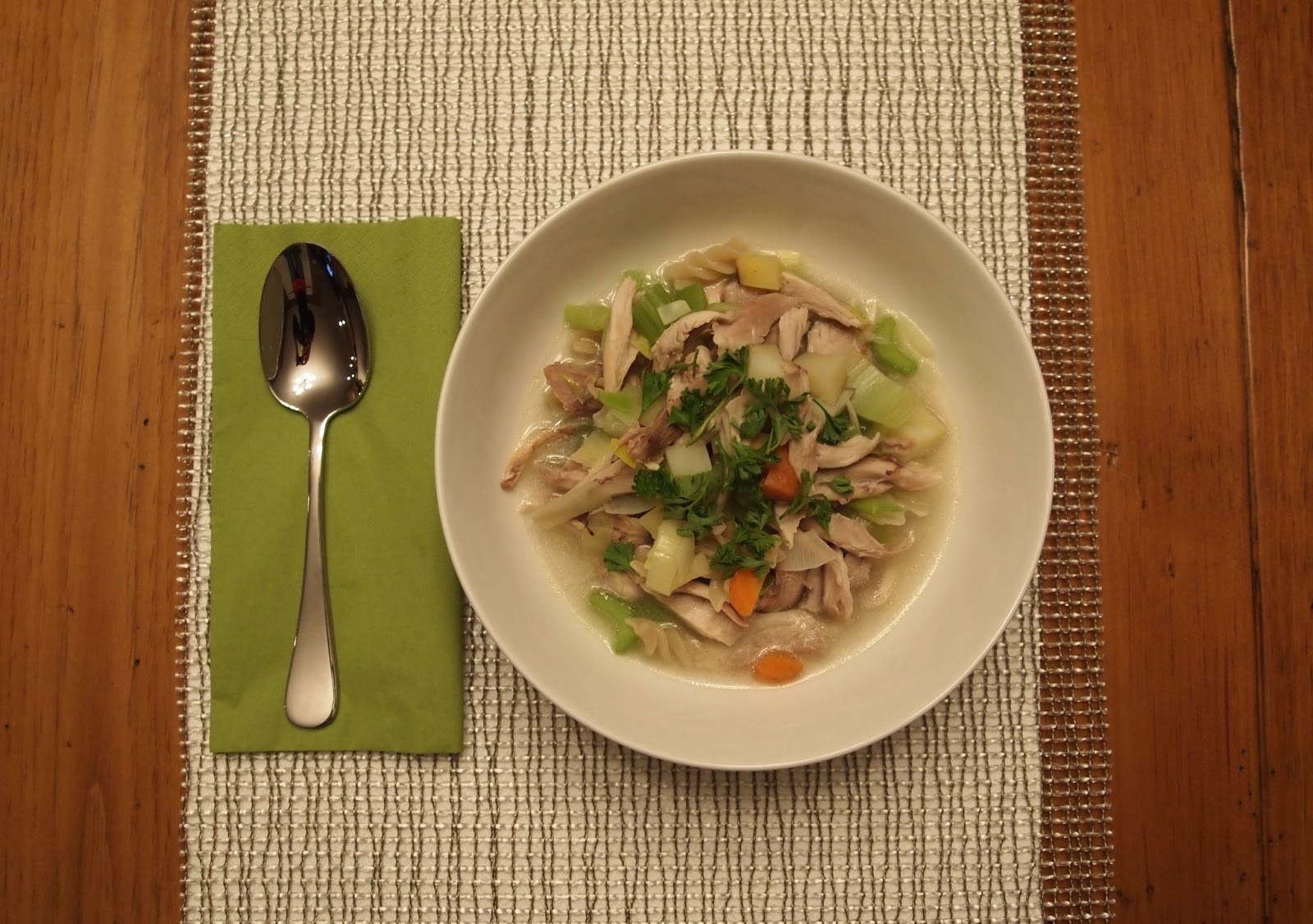
Leek & Chicken Soup
Prep and Cooking Time: Approximately 1 hour 40 minutes
Serves: 4
 |
| Making the broth |
8 organic chicken drumsticks
2 carrots, diced
2 celery sticks, diced
1/2 bunch parsley
Approx. 30 grams of organic butter
2 medium-sized leeks, pale parts only
2 large potatoes
1/4 cup (55g) rice pasta
Instructions:
1. For the broth - place the chicken, 1 carrot, 1 celery and half of the parsley in 12 cups of water in a large pan on high heat. Bring to a boil and then reduce the heat to low and summer for 1 hour so the chicken meat falls off the bones.
2. Strain the broth into a large heatproof bowl and set this aside for now. Discard the vegetables you've used for the broth, and when the chicken is cool enough, remove and discard the skin and bones. (You can soak the chicken in cold water to help it cool down more quickly). Tear the meat into small pieces and set aside.
3. Melt the butter in a large saucepan on medium heat, and cook the leeks for 4-5 minutes until they are soft. Stir in the remaining carrot and celery, and add the potato then cook for 5 minutes.
 |
| Prepping my ingredients while the broth simmers |
5. Add the chicken meat and summer for another 5 minutes, until the pasta is cooked (*hint - for cooking rice pasta, make sure you don't over-cook it by turning the heat off when the pasta is still a little firm and you should end up with perfect pasta.)
6. Serve with the remaining parsley, chopped and sprinkled on top.
Monday, June 18, 2012
Quick & Healthy Minestrone Pasta (GF, Vt)
This is a recipe for a quick, inexpensive meal that is perfect for when you don't have a lot of time to cook, or when you feel too tired to prepare a more time-consuming meal. This would also be great for kids! The recipe I have posted is probably the quickest and cheapest version, and you could add to it to make it a bit more interesting - for example, using fresh vegetables instead of frozen, adding free range chicken or sausages or having it with a slice of bread or salad on the side. I've also added a Printer Friendly option at the bottom of each post so you can print out a copy of the recipes on this site.

Quick & Healthy Minestrone Pasta
Ingredients:
2tbsp olive oil
1 small onion, finely chopped
2 tbsp. tomato puree or paste
300 grams frozen mixed vegetables
700 ml vegetable stock
175 grams pasta (I used Orgran corn/vegetable pasta spirals)
220 gram can of baked beans (make sure there is not a lot of sugar added)
grated cheddar to serve (optional)
grated cheddar to serve (optional)
Instructions:
1. Heat the olive oil in a saucepan over medium heat and fry the onion for 2-3 minutes until it begins to soften.
2. Stir in the tomato puree and add the frozen vegetable and stock.
2. Stir in the tomato puree and add the frozen vegetable and stock.
3. Bring to a boil, then add the pasta and stir the mixture. Cover and simmer until the pasta is cooked.
4. Stir in the beans until they are heated, and serve hot with grated cheese on top (if using).
And enjoy!
Recipe adapted from: www.bbcgoodfood.com/recipes/1465
Saturday, June 9, 2012
10 Ways to Boost Your Immune System

5 Ways to Boost Your Immune System:
1. Eat plenty of colorful, varied fresh fruit and vegetables, especially red, orange and purple colored produce like berries, sweet potatoes and red peppers. Include plenty of vitamin C-rich foods such as broccoli, peppers, peas, cabbage, lemons, oranges and strawberries.
1. Eat plenty of colorful, varied fresh fruit and vegetables, especially red, orange and purple colored produce like berries, sweet potatoes and red peppers. Include plenty of vitamin C-rich foods such as broccoli, peppers, peas, cabbage, lemons, oranges and strawberries.
2. Talk to a health professional about taking immune system boosting supplements. These could include: Vitamin A, a B complex, Vitamin C, Vitamin E, Calcium & Magnesium, Iron, Selenium and/or Zinc.
3. Get enough sunlight, ideally every day. Skin cells produce powerful immune boosting substances and natural daylight stimulates them, which is why it’s important to spend time outdoors every day (approximately 15-20 minutes without sunscreen so your body can absorb enough Vitamin D and possibly a supplement in the winter months). Even better is combining it with some type of exercise outdoors like running, cycling or walking since getting your heart rate up for just 20 minutes, 3 times/week is associated with increased immune function.
4. Try to get good night’s sleep (usually 7-9 hours for an adult).This may be harder depending on your living situation but fatigue increases your susceptibility to illness studies show that your immune function drops by an average of 60% after 3 nights of poor sleep. Like stress, this can cause a rise in inflammation in the body, which is likely because lack of sleep also leads to an increase in the stress hormone cortisol.
5. Do dry skin brushing once per day to activate your immune system. Dry skin brushing has been shown to help strengthen the immune system and can reduce the length of infections and illness by moving the toxins more quickly through the lymphatic system. For instructions on how to perform dry skin brushing see this link: http://articles.herballegacy.com/the-dry-brushing-technique/
5 Ways to Boost Your Immune System When You Feel Like You’re Sick:
1. Increase your intake of Vitamin C. This is one that most people know about, and the ideal daily intake of vitamin C is between 1,000 and 3000mg. For anyone fighting an infection you may need a much larger amount such as up to 20,000mg/day short-term. If you have a cold, take 3 grams (3000mg) every 4 hours until symptoms start to improve. Always take a large doses divided into smaller doses, take lots of fluids at the same time and gradually decrease your intake as you get better. Speak to a health professional in regards to any questions about appropriate dosing of Vitamin C. When you’re sick or coping with additional stress you can take Zinc supplements, and you can often find Vitamin C and Zinc combinations.
2. Take Echinacea droplets or drink Echinacea tea. This is one of the most well-known herbs used for boosting the immune system. It can be taken regularly or when you feel like you’re becoming unwell.
3. Eat lightly and rely mainly on fruits, vegetables and foods rich in Vitamins A and C such as carrots, citrus fruit and green peppers. Some studies show that it can be beneficial to avoid mucus-forming and fatty foods when you’re unwell like meat, eggs and dairy products as they can congest your lymphatic system. (Lymphatic fluid is the main transport for immune cells).
4. Avoid all alcohol, tobacco, black tea and coffee and increase your consumption of water and herbal teas. Some examples of immune system boosting herbs include Cat’s Claw Tea, Echinacea and elderberry extract.
5. Rest and take it easy! Easier said than done, right? But there's a reason we're told to rest when we ge sick, and those around you will be thankful if you take the time to stay home and rest rather than spreading the sickness to them. Try to do everything a bit more slowly when you're unwell so your body can put more energy towards your immune system and fighting off the infection.
Some information from the following sources were used in this article:
Patrick Holford (n.d.). Boost your immunity. Retrieved March 15, 2012 from www.patrickholford.com
Thursday, April 12, 2012
The Dangers of Refined Sugar

"What's so bad about sugar? It's natural, right?""What's wrong with a little bit of sugar now and then?" "Our bodies need sugar for energy". These are all questions and statements I've heard about sugar, and I thought it would be good to talk about them since it is such an important issue when it comes to our health.
First of all, we are genetically programmed to like sugar. It makes us feel good, adds flavor to food, and if you are truly consuming it in very small amounts and eating a healthy and balanced diet, then it is probably not much of an issue. However, one of the problems with sugar is that we are mainly consuming refined sugar, which has been stripped of its vitamins and minerals, leaving only an "empty" calorie that our bodies cannot process properly. Eating refined sugar is actually worse than nothing because it has to leech vitamins and minerals from your body (that would normally be present in it naturally) in order for it to be metabolized.
First of all, we are genetically programmed to like sugar. It makes us feel good, adds flavor to food, and if you are truly consuming it in very small amounts and eating a healthy and balanced diet, then it is probably not much of an issue. However, one of the problems with sugar is that we are mainly consuming refined sugar, which has been stripped of its vitamins and minerals, leaving only an "empty" calorie that our bodies cannot process properly. Eating refined sugar is actually worse than nothing because it has to leech vitamins and minerals from your body (that would normally be present in it naturally) in order for it to be metabolized.
The other big problem is the amount of sugar we consume. Most people in Western societies consume far too much sugar - in energy drinks, sodas, piled into tea and coffee, sweets and deserts and so on. This is compounded by the fact that sugar is added to almost EVERYTHING these days, including soups, crackers, "healthy" cereals, yogurt, pasta sauces, canned vegetables...again, the list goes on. Obviously sugar does not need to be included in these foods, but food companies know that if they add sugar, it will taste better (if you're used to eating it) and that people will buy more of it. They know it's addictive, and they are taking advantage of your health so they can make a higher profit.
Another question or argument that seems to come up is that we NEED sugar - our bodies need sugar for energy. This is of course true, and all carbohydrates are a form of sugar which is the body's primary energy source (once metabolized and broken down into glucose). However, there is a problem with this as well. Because all of these vitamins and minerals have been stripped with refined sugar, the sugar goes into your blood stream much more quickly than if you ate say, a piece of fruit or another type of unrefined carbohydrate that has fiber in it to naturally slow it down. When you eat a type of sugar that immediately goes into your blood stream, your body has to produce more insulin to compensate, and then you "crash", feeling low on energy, and your body tells you you need more sugar to bring your blood sugar back up again. You get stuck in a cycle of highs and lows, which is not healthy or natural and can have a negative impact on your health, including your immune system.
Another question or argument that seems to come up is that we NEED sugar - our bodies need sugar for energy. This is of course true, and all carbohydrates are a form of sugar which is the body's primary energy source (once metabolized and broken down into glucose). However, there is a problem with this as well. Because all of these vitamins and minerals have been stripped with refined sugar, the sugar goes into your blood stream much more quickly than if you ate say, a piece of fruit or another type of unrefined carbohydrate that has fiber in it to naturally slow it down. When you eat a type of sugar that immediately goes into your blood stream, your body has to produce more insulin to compensate, and then you "crash", feeling low on energy, and your body tells you you need more sugar to bring your blood sugar back up again. You get stuck in a cycle of highs and lows, which is not healthy or natural and can have a negative impact on your health, including your immune system.
This leads me to the issue of Diabetes, which is probably one of the main health consequences that people think of when it comes to sugar. When the pancreas constantly has to compensate and produce more insulin to control blood glucose levels, down that road this can cause the pancreas to basically start to burn out until it can't produce enough insulin. This is what can eventually lead to Type 2 Diabetes (and this is a simplified explanation of it, as there are other factors that can contribute to Type 2 Diabetes as well), but evidence does show that increasing the consumption of sugar puts you more at risk for Type 2 Diabetes. Sugar can also lead to Diabetes by weight gain, as the insulin has more difficulty getting through fat around cells to help glucose enter the cell which is how our body cells get the nutrients from the food we eat. Then, the glucose stays in the bloodstream which leads to a multitude of negative effects. There is also evidence that excessive sugar consumption is linked to certain forms of cancer and many other diseases and degenerative conditions. It has also been linked to autoimmune diseases such as arthritis as asthma.
Most people probably know that sugar is bad for your teeth and can cause tooth decay- so if sugar does that to your teeth, what is it doing to the rest of your body? In the book "Sugar Blues" by William Duffy, he notes that "dental researchers have proven that the teeth are subject to the same metabolic processes that affect other organs of the body". Meaning the acid that destroys tooth enamel is also essentially destroying other parts of the body.
Now lets talk about ways to cut down on sugar consumption and better alternatives to refined sugar. When I first tried to cut down it was pretty hard, and I wasn't even eating as much sugar as a lot of people. Once you try and cut down you truly realize how addictive it is, but when you get to the "other side" it feels so much better. I started with not having sugar in my coffee, and diluting fruit juice. Now when I drink a coffee with sugar I think it tastes horrible. Another good tip is to drink a lot of water so you don't get thirsty and crave a sweet drink, and to eat small amounts regularly to keep your blood sugar levels stable. The worst is to let it drop really low and then you will definitely crave sugar and it will be very hard to resist. Another thing you can do that is very important both for overall health, is to read food labels carefully for added sugar. Also watch out for "hidden" terms for sugar, such as corn syrup, dextrose, sucrose, sorbitol and high fructose corn syrup. Another thing you can do it switch to some healthier sugar alternatives, and here are some examples:
Agave Nectar: It is the raw nectar from the agave plant which tastes a bit like honey but has a lower glycemic index, and you can use it the same way you would use honey or also use it as a sugar substitute in baking. You can find it in most health food stores.
Stevia: A natural herb that is very sweet and doesn't have any calories, and you only need a very small amount.
Honey: Honey is a simple sugar, so this one is still with caution/moderation, but if you buy it in its natural/un-pasteurized form then it will contain a lot of healthy enzymes. Heating can destroy the enzymes, making it almost as bad as refined sugar.
Whole Cane Sugar: Unrefined sugar that comes from the sugar cane. It contains the molasses that is normally removed during the refining process (which give refined sugar its white color) so cane sugar has more flavor.
Lastly, here is a link to a site that can be very useful, where you can look up the Glycemic Index of a certain food.The Glycemic Index, or GI is the measure of the effects of carbohydrates in food on blood sugar levels, and estimates how much a certain food will raise a person's blood glucose level after eating it, so ideally you want to aim for foods that have a lower GI.
Wednesday, March 21, 2012
Pasta and Bean Soup (GF, DF, Vt)

Here is a recipe for a hearty and healthy soup, that is vegetarian, gluten-free, dairy free and vegan (if you don't use parmesan cheese). I also like the fact that it is a good recipe for the seasons in New Zealand and Canada currently; NZ being Autumn and Canada Spring. Although, I understand that in some places spring may still feel a bit too winter-ish. If you're feeling down about the weather wherever you are, one positive is that a meal like this is a lot more appealing when the weather is cooler - a warm bowl of soup on a warm summer's day just doesn't work as well.
Pasta and Bean Soup
Ingredients:
90ml extra virgin olive oil
1 onion, peeled and chopped
2 garlic cloves, peeled and chopped
1/2 teaspoon dried chilli flakes
600g mixed vegetables (e.g. courgette, fennel, potato, sweet potato, leek, celery, carrot or peas)
3-4 pinches of dried mixed herbs (e.g. rosemary,oregano and thyme)
salt and freshly ground pepper
sea salt
1 litre vegetable stock
80 g dried pasta (I used gluten-free corn pasta)
1 400g can of beans (e.g. cannellinni, borlotti, haricot or chickpeas) drained and rinsed
2 bay leaves
50g parmesan cheese (optional)
Directions:
1. Heat approx. 60ml of the oil in a pan over medium heat. Add the onion, garlic and chilli flakes and fry for 2-3 minutes, or until they are soft.

2. Add all of the mixed vegetables, except the peas, and the mixed herbs. Season to taste with sea salt and pepper. Fry until the vegetables are soft (or about 2-3 minutes).
3. On medium, cover the pan with a lid and continue to fry for about 10 minutes, stirring regularly, until the vegetables have softened.
4. In a pot (or in the same pan, if you have one big enough) add the stock, pasta, beans, bay leaves and peas and bring to a boil. (If you have put this in a larger pot, add the vegetables). Bring to a simmer and cover for 10-15 minutes or until the vegetables are tender and the pasta has absorbed some of the liquid and is tender. Remove from heat and set aside to cool slightly before serving.
5. To serve, spoon the pasta into serving bowls and sprinkle parmesan cheese over top (if using). Season to taste with black pepper and drizzle a bit of olive oil over each serving.
Serves 4
Recipe adapted from Pasta and Bean Soup (Pasta e Fagioli) - Economy Gastronomy www.bbc.co.uk/food
Monday, February 27, 2012
Healthy Baked Quinoa Oatmeal (GF, SF, Vt)


Preheat the oven to 350 degrees celcius
In a large bowl combine:
1 cup gluten-free flour mix
1 cup quinoa flakes
1/2 cup rolled oats
2 teaspoons cinnamon
1/4 teaspoon ground ginger
1/2 teaspoon salt
In a sepearate bowl combine:
 3/4 cup rice milk (or almond milk)
1/4 cup real maple syrup or honey
1/4 cup yogurt (or applesauce)
Mix the wet ingredients with the dry ingredients and stir to combine. Set aside.
In a baking dish (I used a bread baking dish, it's all I had that was the right size but worked perfectly) add:
1 cup blueberries
 (or any other type of fresh or frozen fruit you love)
1 pear, cut into cubes
1 apple cut into cubes
 (or any other type of fresh or frozen fruit you love)
Spread the quinoa and oat mixture over the fruit, and sprinkle the top with a bit of quinoa
flakes, oatmeal and cinnamon.
flakes, oatmeal and cinnamon.
Bake at 350 degrees for about 30 minutes, until the top is golden brown and the fruit starts to bubble.
Serve warm, topped with yogurt or eat plain.
Recipe adapted from The Sensitive Pantry.
Serve warm, topped with yogurt or eat plain.
Recipe adapted from The Sensitive Pantry.
Sunday, January 22, 2012
Sushi Rolls with Brown Rice (GF, DF)
 Sushi rolls! They are a delicious and healthy option for both dinners and lunches, and are simple and inexpensive to make. They are also a great snack food and easy to take on trips, picnics, to work etc. The seaweed contains many trace minerals, the brown rice is a whole food that is packed with fiber, vitamins and minerals, and then you can add whatever vegetables you like and meat or tofu - or stick with just the veggies. (I have included them in the category 'vegetarian recipes since they are easy to make vegetarian, even though the ones in these photos that I made contain tuna fish.) Most people will be familiar with different kinds of rolls that are out there and you can suit what you put in them to what you like.
Brown rice is unrefined and is the whole grain; the germ, the bran and the starch along with all of their vital nutrients. When rice is milled into white rice, the bran and germ are removed and only the starch is left behind, meaning that white rice and its products have much less nutritional value. Brown rice is a whole food, which as mentioned before is high in dietary fiber, vitamins and minerals. It also contains essential oils and protective antioxidants. Rice bran has even been found to be one of the must nutrient dense substances to ever be studied!

Ingredients:
2 cups of brown rice (regular, long grain or sushi rice)
2 cups of water
A pinch of sea salt
Carrots sliced thin
Cucumber sliced thin
Avocado sliced thin
Green onions sliced thin
Meat and tofu options:
Canned tuna
Cooked salmon
Raw sashimi-grade salmon or tuna
Chicken/teriyaki chicken
Sauteed tofu
Rice vinegar and mirin for cooked rice (optional)
Nori sheets
Sushi roller
Instructions:
1. Place the rice and water into a large pot and bring to a boil, stirring regularly.
2. Lower heat to a simmer and cover for 25-30 minutes.
3.Remove from heat and let stand for 10-15 minutes.

4. Season rice with 2-4 tablespoons rice vinegar and 2-4 tablespoons mirin (optional) and a pinch of sea salt.
5. While the rice is cooking, you can prepare your vegetables and other ingredients.
6. Place a sheet of nori shiny side down on the sushi roller and spread a thin layer of rice to 2 inches below the top of
the sheet.
7. Put the veggies at the top of the sheet (as shown in the photo) and tightly roll from the veggie side.
8. Seal the nori by putting a bit of water on the end to help the ends stick together.
9. Roll the nori in the sushi roller firmly.
10. Slice with a serrated knife that has been dipped in water, and enjoy plain, with wasabi, ginger, soy sauce, tamari or another dipping sauce of your choice.
Saturday, November 5, 2011
Sweet & Sour Steam-Fry (GF, DF, Vt)
 This is a delicious and healthy Chinese-style meal that I got from Patrick Holford's website:
http://www.patrickholford.com/. It lists both chicken and tofu in the ingredients, and you can use both, or one or the other. I used just the tofu this time since I had already had chicken with another meal that week. It's called a steam-fry instead of a stir-fry because of the method used to cook the ingredients, and steam-frying is said to be a healthy way to cook vegetables. What you do is put some oil in a pan to sautee the veggies, then add water to the pan and cover, which allows the steam to cook the food. When everything is cooked you can take off the lid and boil off the rest of the liquid (or you can drain it as well).
Sweet & Sour Steam-Fry
Ingredients:
1 tablespoon olive oil
1 garlic clove, chopped
1/2 of an onion, chopped
1/2 green pepper, chopped
1/2 red pepper, chopped
1 carrot, sliced
1/2 can pineapple chunks, unsweetened in fruit juice
300 grams of tofu
100 grams of skinles chicken breast, cubed (if using chicken)
Rice noodles or rice
For the sauce:
2 teaspoons corn flour
1/2 of an onion, chopped
1/2 green pepper, chopped
1/2 red pepper, chopped
1 carrot, sliced
1/2 can pineapple chunks, unsweetened in fruit juice
300 grams of tofu
100 grams of skinles chicken breast, cubed (if using chicken)
Rice noodles or rice
For the sauce:
2 teaspoons corn flour
4 tablespoons pineapple juice
3 tablespoons cider vinegar
1 tablespoon brown sugar (good but not essential)
2 teaspoons tamari
1 tablespoon tomato puree
Directions:
1. Lightly fry the tofu in olive oil until it becomes slightly browned
3 tablespoons cider vinegar
1 tablespoon brown sugar (good but not essential)
2 teaspoons tamari
1 tablespoon tomato puree
Directions:
1. Lightly fry the tofu in olive oil until it becomes slightly browned
(if you're using chicken, you can steam-fry the chicken in the oil for about 5 minutes, until cooked through)
2. Steam fry the veggies in olive oil until cooked through
3.Combine the sauce ingredients
4.Add the sauce to the vegetables
5. Add pineapple and tofu (and chicken, if using)
6. Simmer for 3 minutes, stirring
7. Serve with rice noodles or rice
Thursday, October 27, 2011
Top 10 Fruits and Vegetables to Buy Organic

Depending on where you live, it might be easy or very difficult to find a good selection of organic produce. It can also really stretch the budget to buy organic foods. If I could buy everything organic, I probably would - it is better for the environment, since not using pesticides is better for the soil, water and animals/wildlife. (*Update - I have gradually switched to buying more items organic than when I wrote this post, and when I can't buy all organic produce I use a fruit and vegetable wash to help remove wax and agricultural chemicals). Buying organic also generally means supporting smaller farmers, and where I live, it also means supporting smaller companies which does usually equal higher cost. But for a great reason! If we want to see change in this area, we have to be willing to actually pay what it costs to produce organic foods. Eating organic foods can also be for your health - some studies show that non-organic produce still contains residual pesticides even after you wash them. Since buying organic is sometimes quite expensive I wanted to come up with a list of the fruits and vegetables that are most important to buy organic and list some of the ones that are a bit safer to buy non-organic (although buying organic is still better overall for the farmer's and the environment). Here is a list of produce with the highest levels of pesticide contamination, based on information from the USDA (United States Department of Agriculture), listed from highest levels/rates of contamination, and are therefore more important to buy organic:
Nectarines
Sweet Bell peppers
Celery
Pears
Peaches
Apples
Cheries
StrawberriesImported Grapes (i.e. Chile)
Spinach
Now, here is a list of the foods that were found to contain the least amount of pesticides - partially attributed to their thick skin that protect them, and are less important to buy organic if you have to choose:
Asparagus
Avocados
Bananas
Brocolli
Onions
Cauliflower
Corn
Kiwi Fruit
Mangoes
Papaya
It also helps you to think about buying seasonal produce - at first it is frustrating when you go and realize that half of the fruits and veggies on your list aren't there. But then it makes you realize that by shopping at big supermarkets we are never conditioned to think of buying seasonally and locally since there is a fairly consistent selection of produce by shipping it in from other countries when it is out of season. This also means that the food has probably been sitting a lot longer and loosing some nutritional value if it has to come from so far away, which is another great reason to think about buying local seasonal produce. It takes a bit more planning around what you will buy, but getting into the swing of things and thinking seasonally/locally and organic when possible is a great way to work towards healthier and environmentally-conscious food choices.
Monday, October 10, 2011
Pasta with Roasted Vegetables, Tomatoes and Basil (GF, Vt)
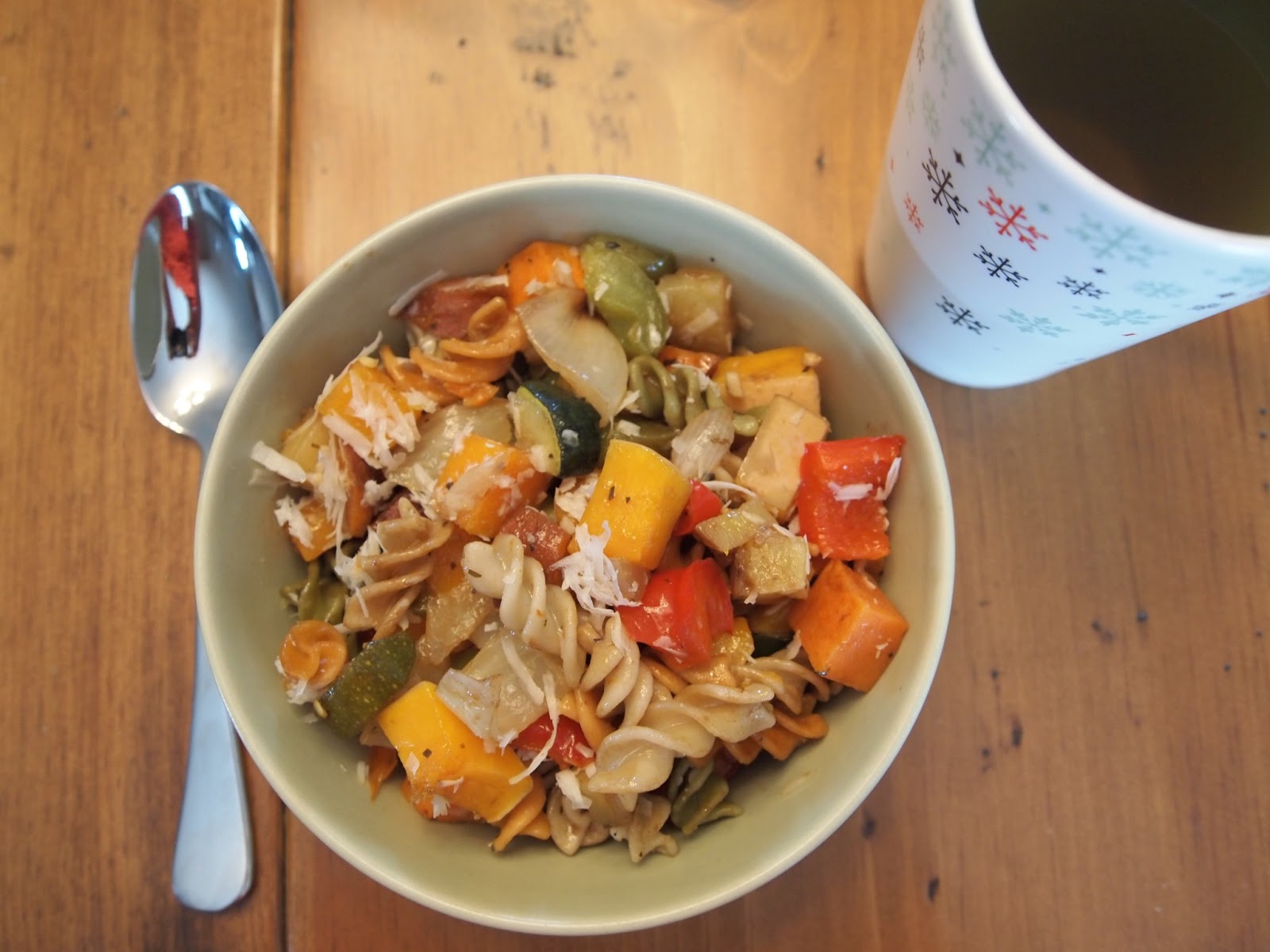 This is one of my favorite recipes right now, and I love the colours of the roasted vegetables just as much as I love the taste. I used brown rice spirals which are gluten-free, but if gluten-free pasta isn't your thing then you can use whatever pasta you like. You can also make it dairy-free and a bit less expensive if you don't use the parmesan cheese. You can also substitute whatever vegetables you like roasting, I like to use sweet potato (or kumara as it is called in New Zealand) because of it's high levels of beta carotene, which is converted in the body to Vitamin A. I also use pumpkin, zuchinni and red peppers. I would highly recommend using fresh basil if possible for this recipe, it really makes it extra good!
Pasta with Roasted Vegetables, Tomatoes and Basil

3 red bell peppers
1 1/2 medium sweet potatoes
2 1/4 cups of pumpkin
1 or 2 zuchinnis (courgettes)
6 tablespoons olive oil
4 cups (approx) pasta of your choice
3 medium tomatoes (I didn't use tomatoes in mine, but it bet they would be good!)
3/4 cup chopped fresh basil or 2 1/4 tablespoons dried
3 tablespoons balsamic vinegar
2 garlic cloves, minced
3/4 cup grated parmesan cheese
Directions:
1. Preheat oven to 250 degree Celsius.
2. Combine sweet potato and pumpkin in a roasting dish, drizzle with olive oil, toss to coat and cook for approximately 10 minutes, or until they start to become slightly soft.
3.Add the rest of the vegetables and garlic, and roast until they are tender and beginning to brown, stirring occasionally, approximately 25 minutes.
4. Meanwhile, cook pasta in a large pot of boiling, salted water until tender but firm to bite. Drain the pasta and save 3/4 cup of the liquid.
5. Combine the pasta, roasted vegetables, tomatoes and basil in a large bowl. Add remaining 3 tablespoons of oil and the balsamic vinegar. Toss to combine (in my photo I have not combined the pasta with everything else, but I would recommend combining it all so the pasta gets the flavor of the balsamic vinegar). You can season the pasta to taste with salt and pepper, and add some reserved cooking liquid by tablespoonfuls to moisten if needed.
6. Serve up the pasta and sprinkle with parmesan cheese. I always like to make extra and take it for lunch the next day since it's really good to eat leftover as well.
Sunday, October 9, 2011
6 Delicious and Healthy Breakfast Ideas
 |
| (Steel-Cut Oats, Honey Yogurt, Peaches, Blueberries, Cinnamon & Nuts) |
But on a happier, healthier note, here are my current favorite breakfast ideas, and I have started making extra most of the time so that I eat half before leaving the house, and then eat the rest at morning tea/break.
6 Healthy Breakfasts I Love:
1) Steel Cut Oats with Plain Yogurt mixed with honey, blueberries, peaches, cinnamon and cashews is the ultimate power-packed breakfast. You can also use regular oats, however I have recently discovered steel cut oats - they are unrefined, whole grain groats (the inner potion of the oat kernel) and have a more dense, creamy texture and a slightly nutty flavour. In Christchurch, I found them at Piko Wholefoods. They take a bit longer to cook than regular oats (about 30 minutes) so if you are in a rush, regular rolled oats or even instant oats are still good options.
2) Cherry & Vanilla Granola with Plain or Honey Yogurt. This is my new, all-time favorite breakfast - it's so good it helps me get up in the morning just because I look forward to it! Liberty Market in Christchurch packages their own granola mixtures so there are other flavors as well, but this one is my personal favorite. It's really reasonably priced as well.
3) Buckwheat Puffs with Rice, Hemp or Almond Milk. This is a breakfast I have started to eat when I need something quick, or when I just want a snack. Some of you may be thinking that buckwheat cereal doesn't sound very appealing, and I thought this too at first. It does take a bit to get used to, just because we're so used to those sugar-filled cereals, and of course, milk. But it is just another thing that I have found gets better each time I eat it. Buckwheat is also a suitable substitute for people who are sensitive to wheat or other grains that contain protein glutens.
4) Scambled Tofu or Scrambled Eggs and Toast.
I always find I feel full for a lot longer when I eat eggs with breakfast (although I am not currently eating eggs after finding out I am allergic to them). You can add some olive oil, your favorite veggies (I like onions, peppers and mushrooms) and eat them with some whole-grain toast or gluten-free toast, which works well since most of the gluten-free bread I've had so far tastes a lot better toasted. I like to have toast with peanut butter or sunflower seed butter and jam, but people here seem to think that is weird!
5) Bean & Rice Breakfast Bowls. This one might sound a bit un-conventional, and this is a recipe I found from one of my favorite websites: Nourishing Meals . It includes a recipe for spicy avocado sauce to go with it. Bean and Rice Breakfast Bowls . This recipe is free from eggs, soy, gluten and dairy and they said they were getting requests for breakfast ideas free of these ingredients, which sounds pretty tricky! As I mentioned, it may sound unconventional, but to many cultures these are food staples that they eat every day, and it is a really healthy and filling option for breakfast.
6) Gluten-Free Pumpkin Pancakes. This is a good recipe for week-ends since I would never be organized enough to make something like early in the morning. This is another recipe I found on Nourishing Meals They have a slight hint of nutmeg and cinnamon, and are delicious with maple syrup. A nice tasty and healthy weekend breakfast, and you can add other things on the side such as yogurt with honey or a fruit bowl. Also very nice with a good cup of coffee or fresh orange juice.Gluten-Free Pumpkin Pancakes
I hope these ideas have given you some inspiration to make some healthy and tasty breakfasts. I know they are not for everyone, but for those of you who are looking to make some healthy changes to your morning routine, taking the time to take care of yourself and make a nourishing meal is a great place to start :)
Saturday, October 8, 2011
10 Ways to Get Enough Calcium in Your Diet Without Dairy
 I wanted to write this article because I think that in Western society we have come to rely much too heavily on milk and dairy products. I really feel there needs to be a be a shift in thinking about the amount of dairy we have always been told we "require" in our diet. I have started to think of dairy as more of a treat than a food staple, and this is still a work in progress for me as well since it's always hard to change eating habits that you have been following your whole life. (Update - since writing this article, I have completely stopped drinking cow's milk and I eat a bit of yogurt and cottage cheese, and a little bit of cheese now and then. Read this article if you would like to learn more about eating less dairy, especially milk: Why Milk Doesn't Do Your Body Good This shift in thinking requires a bit of re-education, since most people automatically think of dairy as the main source of calcium in their diets. Dairy products are also high in saturated fat, and the over-consumption of dairy is just another contributing factor to the obesity epidemic in many Western countries. Generally, the recommended daily amount (RDA) of calcium for women (who need a bit more than men) is between 1000 and 1200 mg but most people consume far more than this. Here is a list of ways that you can get enough calcium in your diet without relying solely on dairy products:
1) Cut Out Soft Drinks. They can cause high phosphate levels in the blood and actually leach calcium from your bones which makes it harder for your body to absorb new calcium.
2) Get Enough Vitamin D. You need to have enough Vitamin D in your body for calcium to be absorbed and used in your system. A good source of Vitamin D is eggs (make sure they are cage-free!), and a bit of sunlight also helps the body absorb Vitamin D.
3) Eat Baked Beans. One cup of baked beans has 154 mg of calcium. And they're cheap! Just make sure you choose a brand that isn't loaded with sugar.4) Eat Canned Salmon. Not my personal favorite, but 3 oz. of canned salmon contains approx. 180 mg of calcium and is also a good source of Omega-3 fatty acids.
5) Eat Calcium-Fortified Foods. A lot of foods these days are fortified with calcium, such as soy milk, almond milk, rice milk and even some breakfast cereals. An 8oz glass of calcium-fortified orange juice contains about 300 mg of calcium, which is about the same as a glass of milk.
6) Eat Oatmeal. One cup of oatmeal provides 100 - 150 mg of calcium.
7) Eat Your Green Veggies. Especially spinach, brocolli and dark green leafy vegetables. Kale, parsley, broccoli, spinach and other dark green leafy veggies provide about 100mg of calcium per serving - try using spinach instead of lettuce in sandwiches and salads.
8) Eat Nuts. Almonds and brazil nuts contain about 100mg of calcium per serving.
9) Drink Calcium-Fortified Orange Juice. Just make sure you get the kind that doesn't have any added sugar.
10) Take Calcium Supplements. If you are still not getting enough calcium through all of these great food sources, then you could consider taking a supplement to make up the difference. I would recommend talking to a Doctor, Naturopath, Registered Dietician or other appropriate health professional about this and they can help you decide if this is right for you and give you advice on a good supplement to take. It is also recommended that supplements be taken as both Calcium and Vitamin D combined rather than Calcium supplements alone.
Here is another article with more great suggestions: 40 Vegan Calcium Sources
Subscribe to:
Posts (Atom)